Monday, 10 February 2014

Golf clubs are even more adjustable than advertised.

I can understand why club manufacturers haven't advertised this fact, but there's actually even more adjustability built into most modern drivers than they claim. However, you also have to be more careful that you don't adjust the wrong things.

Now, I have some other thoughts on what actually happens when the COG of a club is moved around inside the head, but that's for another blog. This one is simply about the drivers and fairway woods built with an adjustable COG system to alter the club's effective loft and face angle.  The examples I have below are of Callaway's Razr Fit 3 wood (2012), but the 2014 Big Berthas have a double cog, which offers even more variations than my examples will.

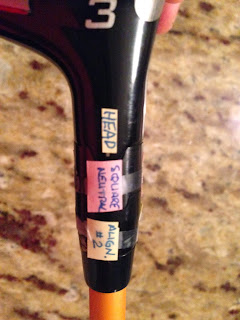
Instead of just 3 different settings in this 3 wood, there are actually 9:
Square/Neutral & Alignment #1 (pic)
Square/Neutral & Alignment #2 (pic)
Square/Neutral & Alignment #3 (pic)
*Open/-Loft & Alignment #1
*Open/-Loft & Alignment #2
*Open/-Loft & Alignment #3 (pic)
*Closed/+Loft & Alignment #1
*Closed/+Loft & Alignment #2 (pic)
*Closed/+Loft & Alignment #3

*Please note that, with these types of single-cog adjustable drivers, opening the face angle also effectively delofts the club, just as closing the face angle will effectively add loft to the club. 


These first 3 images show the same face angle settings in each, but with 3 different ways that the shaft fits into the cog.

Change in a shaft's alignment may result in a (slightly) different flex pattern. Even though the quality control of graphite shafts is much better than it ever has been before, there are still slight variations in most shafts' flex profiles when you rotate it around its longitudinal axis.

It stands to reason that one of the shaft alignments might fit you better than another (again, only fine-tuning the fit of the shaft, not necessarily changing its performance drastically).

Essentially, it allows either 1) a golfer to adjust their face angle and loft while keeping the shaft alignment the same, or 2) a golfer to adjust their shaft alignment while keeping the face angle and loft the same.

If you ever fiddle around with this on the range, you may or may not notice any difference.  However, hopefully this blog will help you make sure that you only adjust what you are intending to adjust.  

All that being said, my philosophy is to stick with the settings that fit you best all the time, and not to tinker too much or to try to adjust your club based on playing conditions.  I think it was Ron Popeil who said, "Set it, and forget it!"

Thanks for looking!

-MS

Sunday, 10 March 2013

What determines how impact will look?

When in problem-solving mode, I like to think that a logical approach is to look at the origin, and work outwards using levels of causation. As golf instructors, we problem-solve every time we give a lesson.

I like to consider ball flight as the origin of a golf shot's problem solving. Well, the only things that "cause" a particular golf shot (excluding post-impact factors such as wind, elevation, etc. and factors individual to the tools used such as clubhead and/or ball design) are the things that make up the ball flight model; D-Plane alignments (3D Face Angle and 3D Club Path), Impact location (where, on the face, the golf club hit the ball), and small considerations for Face rotation through the impact interval (this one's theoretical minutia; interesting, but not worth considering). In other words, the only thing that the golf ball cares about is what the club did to it at impact.

So, the next step outwards in this causation chain (in my opinion), is: what causes the club to move the way it does (and thus deliver it into impact in a particular fashion)? I'd recommend reading up on Dr. Steven Nesbit's work around the golf swing. Most of his stuff is available free of charge at the Journal of Sports Science & Medicine site (www.jssm.org). His work deals with the forces and torques that must be present in a golf swing in order to make the club work the way it does. In other words, the only thing that the golf club cares about is what forces and torques were applied to it in order to make it move in the manner it did.

I'd break it down into the: 1) type of force/torque, 2) the timing of the force/torque, 3) the direction of the force/torque, and 4) the magnitude of the force/torque.

In trying to explain these forces and torques that a golfer can apply to the club, I like to say that anything you can do to a golf club can be described as either: pulling, pushing, or twisting. The pulling force refers to moving the grip of the club in the direction that the grip's butt is pointed. The pushing torque would generally refer to the "releasing" of the club head in relation to the grip (think: the grip stays in the same spot, but the clubhead is orbiting around it). The twisting torque would refer to a screwdriver-like motion with the hands/forearms, causing the club head's sweetspot to rotate around the club shaft's longitudinal axis. I feel that anything one can do to a golf club can be described by combining these actions.


Here's my thesis:
Swing positions only matter to serve the application of these torques and forces, but are not important outside of that. In other words, a golfer's swing positions would be at least 3rd in the "chain of causation" of a golf shot, after their impact alignments and force/torque profiles.

In trying to attempt to "improve" a student's swing, I feel that being overly concerned with positions can be dangerous, in the event that you remove the ability to apply the torques and forces in an optimal manner. In other words, a teacher may be able to have a student achieve a "better" position at the top, for example, but the only way it will actually help the student is if they are able to translate that position into a different pattern of more optimal forces/torques.

Here's one benefit to this approach - some golfers may be able to relate more easily, since these forces/torques are "feels" anyways, not positions that they cannot see with any repeatable accuracy.

Now, this approach may not change much of what some teachers say/do to their students, but it may help in the diagnostic process.

Just my opinion...

References:
Dr. Steven Nesbit
Brian Manzella (PGA) www.brianmanzella.com
Michael Jacobs (PGA) www.xgolfschool.com

Sunday, 30 September 2012

2012 Ryder Cup Musings

10 thoughts (no particular order) on the final day of the 2012 Ryder Cup:

- The way that Jim Furyk tried to use his putter to line himself up on his crucial putt on #18 - I've only seen that done by higher handicaps (no disrespect intended).  Tough year for that guy, "losing" the Ryder Cup, US Open, and a World Golf Championship.

- Lee Westwood came across as relatively useless for the first two days, but came up huge on Sunday, and must feel vindicated.  Highly criticized for his putting the last few years, he made some big ones in his singles match.

- On Martin Kaymer's putt to retain the cup - nice read.  On TV, it broke to the right side of the screen as it rolled past the hole, but broke to the left side of the screen (even if only slightly) back up the hill, on its way to the bottom of the cup.  It would have been easy to misread that after watching it pass the hole.

- I don't think Captain Love (awesome name, btw) can really be criticized by not playing Mickelson/Bradley in all 4 paired matches.  This competition was lost on Sunday; any Ryder Cup Captain would have been quite happy with a 4 point lead with only the singles to go.

- Ian Poulter deserves all the accolades he's getting; the timing of his hot streak on Saturday afternoon couldn't have come at a better time.

- On what appeared to be one of the easier course setups in modern Ryder Cup history, Tiger Woods only managed to hole ONE birdie putt in his singles match (on a par 5, to halve Francesco Molinari).
(I'll never know why he felt like changing his short game and putting along with his most recent swing change.  Even the most dominating player ever has us scratching our heads sometimes, I guess.)
Interesting follow up by Davis Love III in the closing interviews, figuring that Tiger might have been leading had it been a stroke play event.

- Rory McIlroy: like this day needed more story lines, but the kid shows up 11 minutes before his tee time, shoots 65 and beats the match's strongest performer on the other team in Keegan Bradley.  #1 player in the world.

- Both Phil Mickelson (applauded Rose's late heroics) and Justin Rose (restrained celebration on #18 green) carried themselves with a lot of class in the final few holes of their match.

- Jose Maria Olazabal was classy in his acceptance speech; this must have meant a lot to him in honouring Seve Ballesteros.

- I don't think people should question Tiger conceding the final putt.  Finishing 14-14 shouldn't mean more than 14.5-13.5 to the team needing the win.  The tiebreaker is a perk of winning the previous Ryder Cup, and I hope that doesn't change.  I like that it's different than the President's Cup in this regard.

Friday, 6 July 2012

Is Shaft Fitting an Inexact Science?

Is Golf Club Shaft Fitting an Inexact Science?

In 2012, given that the golf industry's shaft manufacturers' tolerances are as good as they have ever been, combined with the ability to measure so much of what the golf club and ball actually do leading up to, during, and after impact, predicting which shafts should best fit individuals should be as easy as ever. However, my opinion is that, while certain features of a shaft (weight, flex, torque, kick point/flex profile, etc.) may tend towards certain ball flight effects, the actual results an individual golfer will experience is very subject dependent, and will .

Even in robot testing, I would guess that different golf-ball-hitting robots (Pingman vs. Iron Byron, for example) would experience different resulting ball flights due to the individual loading patterns of those machines. Furthermore, while the robot itself will perform the same motions each time, regardless of the shaft it is swinging, a human golfer will unavoidably swing differently as shaft characteristics change, making it even more difficult to predict resulting ball flights.

I have seen (launch monitor verified) golfers: swing heavier shafts faster, hit higher kick point shafts on a higher launch, hit lower torque shafts more left (RH golfer), and other feats contrary to the common rules-of-thumb in shaft fitting.  Though they are more rare, these instances suggest that, since the resulting ball flight is ultimately what we're looking at, you might want to try some different flexes (softer and firmer) and weights (heavier and lighter) and see what combination gives you the most consistent launch.

While the fitting process will, no doubt, continue to evolve and improve as player profiling advances, I still think that it is tough to accurately predict the changes in a players ball flight, just based on the different characteristics of the shaft.  You'll have to see it to believe it.

The best avenue for shaft fittings is to try different varieties, with the help of a machine that can accurately measure (at least) ball speed and spin.

Just some of my opinions...

Mark
@StrongerGolf

Wednesday, 28 March 2012

A Golf Shot in detail...

Hello all,

I thought it might be helpful for some people to post up a swing, along with the numbers taken from a launch monitor, and add some diagrams of the 3D shot components.

The 240fps Video Clip is myself hitting a driver one morning in March 2012 at the Vancouver Golf Club's driving range, when snow flurries (visible in the background) discouraged one of my students from showing up, I tried to make use of the extra time.  While it seems important to include video to give everybody a complete picture, I'd like to point out how difficult (impossible) it is to obtain the shot's specs (Plane, Path, Face, D-Plane, and Launch numbers) by visual-only confirmation.  You'd need doppler radar based machines to have an accurate idea.


Here is the ball flight and swing numbers from a Flightscope Screenshot (yes, video and screenshots were from the exact same swing.


Vertical Plane:   47.8°
Horizontal Plane:   4.6°L

Vertical Path/Angle of Attack:   +1.0°
Horizontal Path/Club Path:   5.5°L

Vertical Face/Dynamic Loft:   9.3°
Horizontal Face/ Face Angle:   3.8°L

3D Spin Loft:   8.7°
Spin Axis:   5.5°R

Vertical Launch:   10.6°
Horizontal Launch:   3.5°L

Club Head Speed:    106.2 mph (cut me some slack, it was cold out...)
Ball Speed:    153.5 mph
Smash Factor:    1.45
Spin Rate:    2890 rpm

Here are some still images from my 3D Modelling of this particular shot:


Down The Line view:

Face On view:

Overhead view:

I'll start by pointing out some of the expected relationships between some of these numbers.  Even though my swing's Plane is aligned 4.6° left of the target line, since I'm hitting slightly up on the ball (+1.0°), my club's Path is slightly more left, arriving at 5.5°L.  My natural tendency is to hit down with the driver, but this shot was a conscious attempt to hit up more.

So, there are definitely some things to point out here.

First off, the Launch and Spin Axis of the golf ball do not match perfectly with the D-Plane model (They rarely do, actually, as almost all golf shots experience some amounts of gear effect).  The Expected Spin Axis (assuming centre contact) created by this shot's D-Plane components would have been ~11.5°, instead of the Actual Spin Axis at 5.5°  This suggests that the shot was hit slightly towards the toe (causing the spin axis to tilt more left).  If I'd hit the sweet spot, maybe this shot would have faded all the way back to target...

We also see the Horizontal Launch of the ball as being further right than the Expected Horizontal Launch, which can again be explained by the toe hit (Check out this blog on off-centre contact for related information: The Effects of Miss Hits).

We see a very similar effect in the Face-On view; the Vertical Launch of the ball is actually higher than the Dynamic Loft.  This suggests that the contact was high on the face, which will also normally lower the Spin Rate.  While I'm not sure exactly what Spin Rate should be expected from these specs, I do know that my average Spin Rate is depressingly higher than this shot was.

Now, since this shot has a fairly low Spin Loft, we would expect the initial Launch of the ball to more closely match the club's Face at impact, but have actually launched outside of the D-Plane due to the off-centre contact.  Combining the D-Plane's with knowledge of the effects of off-centre contact can fully explain ANY golf shot.

Feel free to contact me with any questions regarding this, or any other, post.  Thanks for reading!

- Mark

For more information and better explanations on related topics, check out The Complete D-Plane, an educational video by John Graham (JohnGrahamGolf.com & @JohnGrahamGolf) and myself due to be released on April 3rd, 2012.  Follow myself (@StrongerGolf) or John for full details on the release.

Thursday, 12 January 2012

Practicing Golf Properly: Block vs. Random Practice

Do you make the most out of your practice sessions?  Probably not.

First, a couple of quick definitions:
Block Practice - repeating the same motion over and over, perhaps with aids in place to help you be as similar as possible with each rep.
Random Practice - no repetition, each shot is different (either target, club, or ball flight) than the last.

When most people practice, they:
Go to a stall, put down their clubs, and start hitting shots with their wedges (warming up with the shorter shots), and then gradually work their way up the bag to the Driver (and then often spending a lot of time with that club).  They might aim at stuff (they might not).  These days, they might even use an alignment aid of some kind (they might not).  They'll probably leave with some kind of an overall sense of how well they think they hit the ball at the range that day.  Also, for a lot of people, the only time they'll be at the range is right before they are about to tee off.

Well, whether you only make it to the driving range before you play (not ideal, but sometimes people are too busy to practice) or are a regular at your local facility, you should always be trying to make the most of your time.

By combining the Block and Random practice styles, we can start to make better use of our time.

If you are working on something specific (hopefully a tip customized to you by your local PGA professional, and not just the next quick-fix in a long line of trial-and-errors), you can start by working on that after you've warmed up. This is the start of your Block Practice. You may be using alignment aids, checking your setup extra carefully, reminding yourself of that grip change, etc. This is where you are using repetition to make something more familiar. That's all. It shouldn't even make up half of your total practice session (time-wise or shot-wise).

Once we've become a little more familiar with that skill we just worked on, we need to apply it. This is where Random Practice comes into play: removing the repetitive structure of practice and introducing variety. Each and every shot will be a brand new one, requiring your full pre-shot routine for each and every one. Do not hit the same club at the same target more than once, change with each ball.

Some players find it easiest to "play" their regular course (ie. hit their driver as they would on the 1st tee, and go from there), which gives them a chance to react to react to the outcome of the last shot in order to decide which club to hit next (ie. depending on how well you hit your drive, you may have a shorter or longer club for your next).

This kind of practice is much closer to the on-course game of golf than hitting the same 7 iron over and over. The more your practice resembles they way you play on-course, the stronger the bridge between the skills you build on the range and using them in a game situation.

-Mark
@StrongerGolf

Tuesday, 22 November 2011

Spin Loft: Part II - Spin Rate and the Spin Axis

While the Spin Loft of a shot is important, our interest usually lies in how it changes what the ball will do. This post will focus on the spin of the ball for standard, full shots (there are additional factors when talking about shorter, green side shots); which way the ball will spin and how quickly.

As with a lot of my posts, checking out this page of definitions might help with some of the technical terms used.

If you haven't already, you'l probably want to read Spin Loft: Part I - Smash Factor and Ball Speed, as it defines Spin Loft and has some other helpful in there.

A golf shot's Spin Rate is a function of Spin Loft, Clubhead Speed, and contact location. More Spin Loft will result in more spin, as will more Clubhead speed. Less Spin Loft will result in a lower Spin Rate, as will slower Clubhead Speeds. [For complete info on contact location, please refer to my blog post on miss hits.]

These two shots would have identical Spin Rates, all else being equal (assuming no Horizontal Differential):
1) VPath (Angle of Attack): -3.0°, VFace (Dynamic Loft): +9.0°, Spin Loft = 12.0°.
2) Vertical Path: 1.0°, Vertical Face: 13.0°, Spin Loft = 12.0°.
The golf ball doesn't know if it was hit down on or up on, it just knows that it was hit with a 12.0° glancing blow.

So, while changing your Angle of Attack may affect your Spin Rate, it won't if the Dynamic Loft changes by the same amount, since you'd end up with the same Spin Loft (although it would result in a higher launch, since both the Face and Path are more upwards). This means that just hitting more up with your driver will only help you reduce your Spin Rate if you can prevent the Vertical Face (Dynamic Loft) from increasing at the same time.

In simplest terms: the closer the 3D Face and 3D Path are to each other, the lower the Spin Rate will be (also, the higher the Smash Factor and Ball Speed).

Now, the Spin Axis tells us how tilted the D-Plane was, and how sideways the ball will be spinning.  A perfectly straight shot, with no sidespin, is spinning perfectly backwards, around a perfectly horizontal Spin Axis (0.0°).  A theoretical shot with a perfectly vertical, 90.0° Spin Axis (either Left or Right) would be spinning straight sideways.

The Spin Axis will tilt any time the Horizontal Path and Face are not going in the same horizontal direction.  How much it tilts depends on the Horizontal and Vertical Differentials.

Two different golf shots could have identical Horizontal Path and Face numbers, but experience very different Spin Axis numbers, depending on the difference between the vertical components (Vertical Differential).  Shots with very high Vertical Differentials (like wedge shots) stretch the D-Plane upwards resulting in flatter, less tilted Spin Axis numbers than low Vertical Differential shots (like drivers), which will tilt much more.

For example: two shots could share the same Horizontal Differential (difference between path and face, as if viewed from overhead), let's say 3.5°.  The lower Spin Lofted shot (say, with a VDiff of just 5.5°) will experience a tilting of its Spin Axis of 32.7°!  This would not be a useful golf shot at all.  However, the same Horizontal components could result in a Spin Axis tilt of only 6.6° (slight curvature) if its' VDiff was much higher (31.5°).  This sounds like a lot of specific numbers, but it explains why drivers spin sideways way more than wedges.

This is the trade-off between distance and accuracy; lower spin lofted shots will tend to carry further due to higher ball speeds and lower spin rates, but the same shot will tend to spin sideways more if the Path and Face get out of line much.  Given this information, one might decide to try and hit shots with lower Spin Lofts on open driving holes where distance is a priority and hit shots with higher Spin Lofts on holes where you'd want more control.  In fact, Bubba Watson (admittedly, one of the more creative players on Tour) has been measured varying his Vertical Path between -7.5° and +5.0° during competition (Trackman Newsletter #2, Pg. 12), suggesting that he employs this kind of strategy (whether he knows it or not).

So, in summary, a golf ball's spin (amount and direction) is largely controlled by its Spin Loft, which is simply the difference between the Face and Path.

-Mark
@StrongerGolf

Wednesday, 9 November 2011

Thoughts on your Setup

We all know that the setup is important to our golf games, but I'm not sure that enough people know how important it really is.

If you continue to read some of my material (or have already read some), you'll see me often refer to the D-Plane and its components, Path and Face. These are two of the main factors that control our golf ball. Well, even though there's a lot going on in a golf swing and things can change, your Club Face aim at address and the Face at impact will correlate highly with each other. Also, your shoulder alignment at setup and your Path at impact are closely intertwined. In a nutshell, these are the reasons that I feel that your Club Face aim and shoulder alignment are two main aspects of your setup that should be constantly checked.

A phrase I find myself repeating on the lesson tee all the time is, "Never blame anything in your swing for a bad shot before you've eliminated the setup as a source of error."  For example: a pulled shot can be more easily explained by that ball position being too far forward than "coming over the top," "flipping with the hands," or "lifting my head."  I'm always happy to hear students assessing their setup before trying to figure out what went wrong with their swing after a poor shot.


I feel that you need to 1) set up in such a manner that allows you to 2) make a good swing AND 3) get a good result.  Setting up with improper alignment or aim does not allow this to happen.


Another example: if you set up to a straight, 10 foot putt with your putter face aimed to the right of the hole, you will have two (or more) options: either make a great stroke and roll the ball to the right of the hole, or make a compensated stroke to get the ball rolling on line.  Since a good stroke won't reward you with a holed putt, you're likely to change your stroke in a way that will help you make putts.  Perhaps you start to flip the putter head closed or develop a pull stroke from this rightward setup since you'd make more putts doing so.

I also feel very strongly that your setup should strive to be 1) customized to your swing and 2) as consistent as possible.  You can't expect to have a consistent swing without a consistent setup.  In my opinion, practicing without a target can be harmful for most golfers, since they won't get accurate feedback.

Often, in order to affect change in the stroke or swing, the setup will need to be changed first - not only to allow for the physical differences in the motion, but simply to reward the better swing/stroke with a better result.  New behaviours are more likely to be adopted if you get rewarded (with better shots) for doing so.


A little off-topic: The TV commentators that analyze swings in 30 seconds after one quick look do not have an easy task, so I don't mind cutting them some slack (although you do hear some pretty questionable info from time to time). However, I don't understand why a commentator has never suggested, "his alignment looks a little closed," when a poor shot is being replayed and analyzed. Instead of saying something like "he was late with his hands," why not suggest that the same player may have simply been aligned a bit right?  If all the Average Joe's out there are listening to the commentators, golfers will always be analyzing their swings, and always neglecting their setups.


Those are my opinions, nothing more.

-Mark
@StrongerGolf

Tuesday, 8 November 2011

Spin Loft: Part I - Smash Factor and Ball Speed

Have you ever been told to hit up more to make your drives fly further?  Ideas like these are fine, but are only correct if you understand what else is going on at the same time.  Hopefully I'll make things a little more clearer in this blog post regarding 3D Spin Loft, Smash Factor, and Ball Speed.

As with a lot of my posts, checking out this page of definitions might help with some of the technical terms used.

There are a lot of directions that you could go when talking about Spin Loft: how it affects the Smash Factor and Ball Speed, how it affects the Spin Rate of the shot, or how it affects the Spin Axis and the curvature of the shot.  Before we go there, I'd like to define Spin Loft.

Trackman defines Spin Loft as the difference between dynamic loft and the attack angle (Pg. 7, Trackman's Glossary).  Unfortunately, this is incomplete as they are only looking at the vertical components (dynamic loft = Vertical Face, attack angle = Vertical Path), and disregarding the horizontal aspects of the shot.  Spin Loft needs to be measured/considered in 3D, combining both the Vertical and Horizontal Differentials (think: perpendicular to the Spin Axis, instead of just an arbitrary direction like up), in order to properly account for its effects on ball flight.  Spin Loft is actually the angle between the 3D Path and 3D Face, which is different than just looking at the vertical components, as if from a face-on view.

As an example of 3D Spin Loft, let's take a shot with a downward VPath of 5.0° and a VFace of 25.0°.  The Vertical Differential, or Trackman's Spin Loft, is 30.0 degrees.  However, if this same shot had an HFace of 5.0°R (Face is aimed 5 degrees right of the target line) and an HPath of 10.0°L (Path is going 10 degrees left of the target line), we have to take the 15.0° Horizontal Differential into account.  The difference between the horizontal components stretches the Spin Loft and, in this case, combines with the Vertical Differential to result in a 3D Spin Loft of 33.5°.  While it's not a monumental difference, we've still discovered more than 10% extra to the measurement that only took the vertical components into account; this higher number will more closely correlate with other measurements such as Spin Rate and Smash Factor.

Another definition: Smash Factor is easy to figure out; it's simply a ratio of the resulting ball speed to the shot's club head speed (Smash Factor = Ball Speed / Clubhead speed, eg. 145mph Ball Speed / 100mph Clubhead speed = 1.45 Smash Factor).  Newer drivers have been maxed out in terms of their COR (trampoline effect), so you won't see too many Smash Factors over 1.5, with legal golf clubs, anyways.

Lower spin lofts create more compression, so we get higher resulting ball speeds (and, therefore smash factors). Higher Spin Lofts are more of a glancing strike, so less energy goes into propelling the ball, and you get slower ball speeds.  While there are a few factors in play (shorter shafts resulting in slower clubhead speeds, for one) causing wedge ball speeds to be significantly lower than wood ball speeds, Spin Loft is the major one.

In terms of maximizing our driving distance with a given swing speed, lower Spin Lofts have the double benefit of increasing Ball Speed and decreasing the Spin Rate; both of which will increase driving distance for almost anybody out there. I'll discuss how the Spin Rate comes into play, as well as talk about the downside of lower Spin Lofted shots in the next Blog post, Spin Loft: Part II - Spin Rate and Spin Axis.

Summary:
As Spin Loft decreases, effective compression increases = Smash Factor and Ball Speed increase.
As Spin Loft increases, effective compression decreases = Smash Factor and Ball Speed decrease.

Thanks for reading, feel free to ask any questions.

-Mark
@StrongerGolf

Nov. 27th Follow Up:

Here's a chart showing the relationship between Smash Factor and Spin Loft.  Since the data is from Trackman, it isn't 3D Spin Loft being measured, but Vertical Differential.  I have no doubt that, if the data for these shots' horizontal components were available, the correlation would be even stronger between Smash Factor and 3D Spin Loft.


Monday, 7 November 2011

The Effects of Miss Hits

Most of the literature you read regarding Golf's Ball Flight (D-Plane geometry, Impact Plane geometry, etc.) offer explanations of ball flight based on centred (sweet spot) contact. I think it's very important to understand how that relationship works, but also think that being aware of all the effects of non-centred contact has on a golf shot is fairly important, given that a fair number of any average golfer's shots are not hit on the Sweet Spot.

When we look at analyzing miss hit shots, we'll consider shots missing the sweet spot in 4 directions: towards the toe, towards the heel, high on the face, and low on the face. Of course, you can combine these influences should you want to look at a high-toe miss, for example.

When the clubface impacts with the ball, the surface of the ball is in contact with the face for mere milliseconds, but this is when all the influence happens. When the ball is not hit on the centre of percussion (sweet spot), the face will rotate towards the direction of contact, even as the ball is still compressed against it. Since the face will be more open at separation (when the ball leaves the face) than it was at impact, the Effective Face angles (the ones we use in D-Plane calculations) will come from where they were in the middle of the Impact Interval (also the time when the ball is at maximum compression). Also, the twisting open of the face has the effect of spinning the ball in the opposite direction. This is called Gear Effect.


If we break the golf ball's flight down to it's initial components, we'll have: Ball Speed, Vertical Launch, Horizontal Launch, Spin Rate, and the Spin Axis (indicates how sideways a ball is spinning). This list takes care of pretty much everything that the golf ball will do upon being launched. We'll look at how the different miss hits affect each component.

Smash Factor: Not too surprisingly, when we hit the ball away from the sweet spot we see a lower Smash Factor, which is the ratio of ball speed to club speed (Smash Factor = Ball Speed / Club Head Speed, eg. 147mph Ball Speed / 100mph Club Head Speed = 1.47 Smash Factor). The higher the Smash Factor, the higher the resulting Ball Speed (Driver shots have much higher smash factors than wedges). Shots hit towards the heel will see a lower ball speed than sweet spot contact. Shots hit towards the toe will also see a reduction in ball speed, but less so since the face at the toe of the club is actually moving slightly faster than the face at the sweet spot (since the face is rotating around the hosel). As a side note: higher smash factors are a result of higher COR and lower Spin Loft numbers, but that's for another blog...

Toe hits: When the ball impacts the face towards the toe, the face opens immediately, and this opening is what causes the following effects:
Smash Factor/Ball Speed - lower, but higher than heel hits
Launch - more right*
Spin Rate - slightly higher
Spin Axis - tilted more left

Heel hits: face rotates closed and:
Smash Factor/Ball Speed - lower
Launch - more left*
Spin Rate - slightly higher
Spin Axis - tilted more right

Hit high on the face: face rotates upwards and:
Smash Factor/Ball Speed - lower
Launch - higher
Spin Rate - lower
Spin Axis - unchanged

Hit low on the face: face rotates downwards more than normally:
Smash Factor/Ball Speed - lower
Launch - lower
Spin Rate - higher
Spin Axis - unchanged

*I've put asterisks on two effects that Trackman (a leader in this area of research) disagrees with me on. They still maintain that the effects of off centre contact do not include a change in horizontal launch (Trackman Newsletter #5, pg. 3).  I believe that Trackman would agree that low-face contact will result in a lower launch, and that high-face contact will result in a higher launch.  It would be due to the same effect that happens in the horizontal frame, so why the difference?  I think it has something to do with the way that Trackman calculates and presents their Face numbers, likely displaying the Effective Face angles from the middle of the impact interval (but that has twisted from its "delivered" condition).  
They could consider showing two sets of numbers for the Face - "delivered" (by the player) and "effective" (post-twisting).  A small difference in the numbers would indicate better contact.
Dave Pelz found that the effects of heel impact on putts sent the initial launch of the ball to the left (RH golfers) and that toe hits sent the ball to the right (Dave Pelz's Putting Bible, pg 354).  I think it's fair to assume that the same principles apply to the initial launch of a golf ball in putting, as well as full shots.

Interestingly enough, the combination of hitting a drive off the high-toe is not necessarily a bad miss hit for a lot of people. The combined effects of more draw spin (leftward tilted spin axis), higher launch, and less spin can actually help certain people hit it further and straighter than they normally would.

Side Note: Clubs are now being designed with higher Moment of Inertia (MOI), which will increase the club head's resistance to twisting. Less twisting means smaller effects on off centre hits, in terms of spin and launch.  Club with different Centres of Gravity (COG) will experience different degrees of twisting and Gear Effect; the further behind the face that the COG sits (like in fairway woods and drivers), the more twisting that will occur on those off-centre hits, and the more exaggerated these effects will be.

So, if you're watching ball flight on the range, and are trying to figure out what the club is doing to cause that flight, you might want to consider non-centred contact (it happens a lot).

Thanks for reading (sorry for all the brackets)!

-Mark
@StrongerGolf

References:

Jorgensen, T. (1994). The Physics of Golf. AIS Press

Cross, R. (2006). Physics of Golf.
Retrieved from http://www.physics.usyd.edu.au/~cross/GOLF/GOLF.htm

Friday, 28 October 2011

Welcome to the StrongerGolf Blog

Hi There,

You've reached the StrongerGolf Blog, my outlet for golf-related thoughts. My name is Mark Strong, a Canadian PGA professional here in Vancouver, BC. I'll be periodically blogging about random or requested golf topics, a very common subject being ball flight. If you like what you read (or even if you don't), follow my blog, comment on posts, and let me know your thoughts.

Thank you for reading; I hope you enjoy your time here.


The D-Plane: New and Old

Golf Instructors: What is it about the D-Plane that seems to split the golf teaching community into two camps?

This blog isn't really about the D-Plane, as much as it is about what seems to have happened in the golf instruction industry since it's reference has become more commonplace.

It doesn't make you a bad teacher if you don't know the D-Plane right now.  It doesn't make you a good teacher just because you do know the D-Plane.  However, knowing the D-Plane, just like knowing anything else, will make a teacher better than he/she was before.  At least, it can't make you worse.  How a teacher chooses to use the information is up to them, and is where the real skill in teaching likely lies.

New information regarding the golf swing is coming out at a pretty steady rate these days.  While the D-Plane isn't really "new" since it's been published for a while (Ted Jorgensen, The Physics of Golf. 1993), its measurements (Angle of Attack, Dynamic Loft, etc.) are now more commonly referenced since we have machines (Trackman and Flightscope) that can measure them.  There are even more advancements coming out in the field of biomechanics for the same reasons; we now have machines (K-Vest, AMM 3D, etc.) that measure what the entire body does during an elite golfer's swing, as well as have common access to slow motion cameras capturing in video in 1000 frames per second, so that few images are missed.  Several researchers, including Dr. Rob Neal and his company, Golf Biodynamics, have measured thousands of swings, and have enough data to make some very concrete assertions about what kinds of things happen in good golf swings.

For example: during the release of the golf club, before the clubhead impacts the ball, the point between the hands is actually moving upwards, helping to release the club downwards.  This has been now been measured over and over again.  You may have known that, taught that, or both.  You may not have known that.  It doesn't mean that telling a student to drive their hands "down and through the ball" couldn't help them, it just means that it doesn't actually happen in the most efficient, effective golf swings.

This wave of "new" information does not mean that anything taught beforehand was wrong, but might help explain why the things taught beforehand that worked did so.

My point in this blog is that simply knowing this information or not doesn't necessarily reflect at all on the instructor's ability to make his/her students play better golf.  Some instructors have surely used a feel like this with students to try and help their swings.  While something like this is fact, and not really up for debate anymore, it doesn't mean that instructing your students to swing your hands "down through the ball" couldn't help them.  Many differences between "feel and real" in the golf swing are referred to all the time, and since the goal of instruction is to have the students improve, in my opinion the better teacher is the one who gets the student to improve more, not necessarily the one who told the student the most correct information.

I don't meant to pick on anybody out there, but - to the guy who tells his students that the ball will start to fly along the path that the club was moving on when it hit the ball, and will curve and end up where the face was pointed at impact- if using that phrasing helps your students more than a more correct explanation would, then you've done your job.

By the way, ultra-simplified ball flight explanation: The golf ball will launch roughly 3/4 of the way between the face of the club and the path of the club head through impact, and spin in the direction away from the path.  You can get WAY more specific than that, in many different ways, but hopefully that one sentence will be accepted as fact.

Personally, I don't see why, as a teacher, knowing the correct information could ever hurt, but:

1. What the teacher wants the student to do
2. What the student was told to do
3. What the students tries to do
4. What the student actually does

you gotta admit that there's a lot of chances for information to change, and getting #4 to be good as possible is the achievement of an excellent teacher, regardless of what #'s 1, 2, and 3 were.

Those are just my opinions, which sometimes change...but not usually.
:)
-Mark
@StrongerGolf


Thursday, 27 October 2011

The use of video in Teaching

Is video analysis overused in golf instruction, or is it an invaluable tool to the professional teacher?

Video has been in common use for quite some time now, and I think it's fair to say that most teaching professionals use video in their teaching, at least from time to time.  

While it can be very useful to help catch certain happenings of the swing that cannot be seen by any naked eye, I think it's important to be aware of a few of the pitfalls a teacher can experience when using video.

Parallax / Consistency: It's important to make sure that, if you are going to be comparing before and after shots or shots between two different golfers, you have the camera in the exact same position relative to both the student and the target.  Otherwise, you might see differences or similarities that aren't necessarily there.  I've seen examples of the same, exact swing satisfying two teachers with opposing philosophies just because of a difference in camera placement.  


Wikipedia's definition of Parallax: http://en.wikipedia.org/wiki/Parallax

For example, let's say a student strives to have their club shaft parallel to the target line in their takeaway/backswing when it reaches level with their hands/parallel to the ground (the clubhead could appear to cover the hands at this point).  Well, a camera placement very slightly to the left will give the impression that the clubhead is more outside the hands (RH golfer), while a camera placement a little to the right would make the takeaway look much inside than it actually is (again, RH golfer).

Method of screen capture: My technical information on cameras isn't all that great but, the way I understand it is that a camera takes each frame in a "wipe" method from top to bottom.  This means that the lower part of the image is actually very slightly delayed relative to the top portions.  In some older 30 frames-per-second video, this shows up as the clubhead having way more lag than is revealed in high speed video (240+ fps), and other distortions ("rolling shutter" problem).  Interestingly enough, this problem can be somewhat countered by turning the camera upside down when filming, and then flipping the image back the right way afterwards.

In short, I believe that video (especially 240+ frames per second, High speed video - very smooth in slow motion) can be very valuable, but is often overused.  I often caution against drawing too many lines on the screen, because it could encourage the exact re-creating of those lines by the student.  "Isn't that what the student and teacher both want," you might ask?  Well, only if you have properly accounted for the pitfall phenomena mentioned above.

If you rely on video too much, and draw lots of lines for your students, you might find that you occasionally "prove" your own teachings to be wrong when they're actually right, or convince both of you that a change is there, when it actually isn't.

Those are my thoughts, take 'em for what they're worth.
Thanks for reading.

-Mark
@StrongerGolf